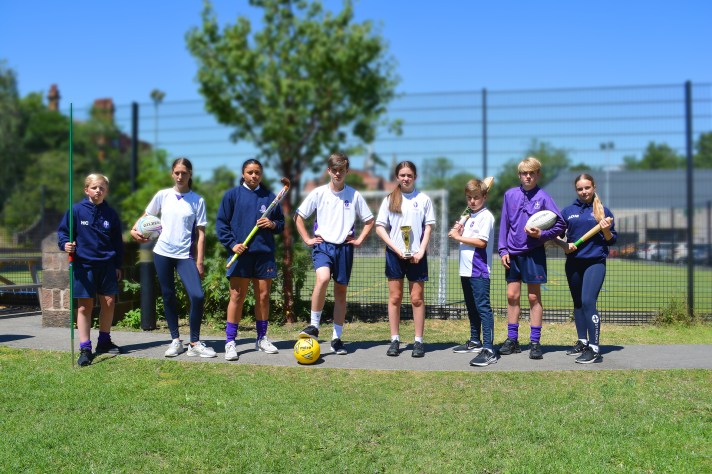
Please note: students will learn the sports in different orders. Please ignore the unit numbers.
> Unit 1: Football
“Behind every kick of a ball, there has to be a thought.”
Denis Bergkamp
After this unit, you will know:
- How to pass the ball between people to create an attack
- How to move into space to receive the ball or create space for others to move in to
- How to shoot the ball for power or placement/accuracy
- How to dribble the ball
- Some of the pitch markings and some rules to promote fair play
- Basic tactics such as positions to aid team performance
- The impact on health and fitness and the components of fitness required to perform well
You will need to remember:
- · Accurate passing requires eye contact, verbal communication and the correct amount of power
- Moving into space may allow you to get the ball or create opportunity for others to receive or dribble
- Different parts of the foot can create different outcome for the ball
- When dribbling to make use of multiple, light touches on the ball, using various parts of the foot
- Dribbling with your head up, change of speed and direction can improve chances of outwitting your opponent
- Being a team sport, not everyone can be in every position on the pitch
You will be able to do the following:
- Execute passes using the inside of the foot
- Take a shot from a standing position
- Be able to move into space to receive the ball
- Dribble the ball using a dominant foot in straight line and changing direction
- Participate in games of football





> Unit2: Badminton
After this unit, you will know:
- How to hold the racquet to be able to serve and hit the shuttle overhead and underarm
- Where to position yourself on the court for service and general play
- Basic rules to promote fair play
- The impact on health and fitness and the components of fitness required to perform well
You will need to remember:
- The middle of the court is the best place to position yourself during a rally or game
- Which box to serve from based on the score of the game
- Some of the rules in order to allow for fair play
You will be able to do the following:
- Execute a range of shots such as serve, overhead and underarm
- Rally the shuttle with another person over the net
- Be able to score and play a game against another person
- Be able to umpire a game (keeping score and service)
> Unit 3: Rugby
After this unit, you will know:
- How to pass the ball between players
- How to move into space to receive the ball or create space for others to move in to
- How to get the ball off the opposition
- How to effectively run with the ball
- Some of the pitch markings and some rules to promote fair play
- Basic tactics such as positions to aid team performance
- The impact on health and fitness and the components of fitness required to perform well
You will need to remember:
- The ball must travel back or to the side when passing
- Moving into space may allow to you get the ball or create opportunity for others to receive or make a run
- Aiming for the waist/upper legs will allow for getting the ball off the opposition
- Running with your head up, change of speed and direction can improve chances of outwitting your opponent
- Being a team sport, not everyone can be in every position on the pitch
You will be able to do the following:
- To be able to pass the ball to another person whilst on the move
- Complete a safe tackle / tag to prevent the opposition from progressing
- Run with the ball to prevent losing control of it
- Participate in games of rugby
> Unit 4: Gymnastics
After this unit, you will know:
- How to best control your body to prevent falling
- The correct technique when holding a balance
- The ideal technique when travelling across the mat
- Basic strategies to aid performance
- The impact on health and fitness and the components of fitness required to perform well
You will need to remember:
- A balance must be held for up to 3 seconds to be accredited
- Having full extension of arms and legs can score higher
You will be able to do the following:
- Perform balances as an individual, in pairs and small groups
- Make use of small pieces of apparatus within a routine
> Unit 5: Basketball
After this unit, you will know:
- How to pass the ball between people to create an attack
- How to move into space to receive the ball or create space for others to move in to
- How to shoot the ball to increase the chances of success
- How to dribble the ball
- Some of the court markings and some rules to promote fair play
- Basic tactics to aid team performance
- The impact on health and fitness and the components of fitness required to perform well
You will need to remember:
- Accurate passing requires eye contact, verbal communication and the correct amount of power
- When shooting to bend the knees and shoot the ball high increases chance of success
- Moving into space may allow you to get the ball or create opportunity for others to receive
- When dribbling attempt to have your head up, use finger tips and bounce below hip height
- When dribbling with your head up, change of speed and direction can improve chances of outwitting your opponent
- Being a team sport, not everyone can be in every position on the pitch
You will be able to do the following:
- Execute a range of passes (chest, bounce, overhead)
- Take a shot from a standing position
- Be able to move into space to receive the ball
- Dribble the ball using a dominant hand in straight line and changing direction
- Participate in games of basketball
> Unit 6: Netball
After this unit, you will know:
- How to pass the ball between people to create an attack
- How to move into space to receive the ball or create space for others to move in to
- How to shoot the ball to increase the chances of success
- Certain positons can only play in certain places on the court
- Some of the court markings and some rules to promote fair play
- Basic tactics to aid team performance
- The impact on health and fitness and the components of fitness required to perform well
You will need to remember:
- Accurate passing requires eye contact, verbal communication and the correct amount of power
- When shooting to bend the knees and shoot the ball high increases chance of success
- Moving into space may allow you to get the ball or create opportunity for others to receive
- Being a team sport, not everyone can be in every position on the pitch
- In netball, certain positions can only play in certain areas of the court
You will be able to do the following:
- Execute a range of passes (chest, bounce, overhead)
- Take a shot from a standing position
- Be able to move into space to receive the ball
- Participate in games of netball
> Unit 7: Athletics
After this unit, you will know:
- There is 2 aspects to athletics (track & field)
- How to effectively pace a middle distance race to minimize the need to walk
- The basic commands when starting a sprint race
- When measuring a jump it is the closest point to the line that is measured
- When measuring a throw, it is where is first lands not where is finishes
- Basic strategies/tactics to aid performance
- The impact on health and fitness and the components of fitness required to perform well
You will need to remember:
- When throwing, power/distance comes from the legs
- The technique for sprinting if different to that of running
- It is harder to start running again once you have started to walk, pacing is the better option
- There is three commands when starting a running race
- Safety when throwing to remain behind the line until told
You will be able to do the following:
- Perform in the majority of athletics events with basic technique
- Start a race fairly
- Be able to run for a period of time that is well paced
- Be able to throw a shot putt, discus and javelin with basic technique
- Be able to jump with confidence in either long, triple or high jump
> Unit 8: Softball
After this unit, you will know:
- The game requires a person to bat and field
- That you have three attempts to hit the ball when batting
- The ball must travel forward when batting
- A swing of the bat is classed as a shot and a strike regardless of the ball quality
- The basic technique for making a catch using a mit
- Some of the rules to promote fair play
- Basic strategies/tactics to aid team performance
- The impact on health and fitness and the components of fitness required to perform well
You will need to remember:
- To stand side on with bat raised in two hands with the batting plate in front of you when batting
- To stand on the inside of the base
- You can’t run when a ‘foul’ ball is hit or a catch is made
- If the ball is above your shoulder or below your knee it is a no ball
- To run around the bases
- When trying to get a person out the ball must go to the base a batter is running to
You will be able to do the following:
- Participate in games of softball
- Bowl the ball using underarm pitch
- Score/umpire a game of softball fairly
- Go about the process of batting attempting to hit the ball
> Unit 9: Cricket
After this unit, you will know:
- The game requires a person to bat and field
- There is two main types of throw used when fielding in cricket
- When to use a long barrier or short barrier to field the ball
- The basic technique for making a catch
- The correct stance when batting
- How to bowl the ball
- Some of the rules to promote fair play
- Basic strategies/tactics to aid team performance
- The impact on health and fitness and the components of fitness required to perform well
You will need to remember:
- You don’t have to run when you hit the ball you can stay
- You can run even if you don’t hit the ball
- To stand side on away from the stumps when batting
- To keep your arm straight when bowling
- When trying to get a person out the ball must go to the end a batter is running to
You will be able to do the following:
- Participate in games of cricket
- Umpire a game of cricket fairly
- Attempt to bat and bowl using the correct technique
- Have some success when batting or bowling in cricket
> Unit 10: Rounders
After this unit, you will know:
- The game requires a person to bat and field
- There is two main types of throw used when fielding in rounders
- When to use a long barrier or short barrier to field the ball
- That you have one attempt to hit the ball when batting
- The basic technique for making a catch
- Some of the rules to promote fair play
- Basic strategies/tactics to aid team performance
- The impact on health and fitness and the components of fitness required to perform well
You will need to remember:
- To stand side on with bat raised in one hand inside the batting box when batting
- Underarm is for short distance fielding overarm is for long distance fielding
- The ball travels quicker than a person – better to throw than to run with the ball
- To stand on the inside of the post/base
- If the ball is above your shoulder or below your knee it is a no ball
- To run around the bases
- You can score by getting to 2nd base or 4th base when you have hit the ball
- If the ball is hit behind, you must wait at 1st base until the ball crosses
- When trying to get a person out the ball must go to the base a batter is running to
You will be able to do the following:
- Participate in games of rounders
- Bowl the ball using underarm bowl
- Score/umpire a game of rounders fairly
- Go about the process of batting attempting to hit the ball
Assessments
For your mid-year assessment, you will need to know:

For your end of year assessment, you will need to know:
 The Home of our curriculum