How can my child become a better reader?
There are 2 key factors that make us good readers:
- our ability to fluently recognise words and
- our ability to comprehend what these words mean.
This was outlined by Gough and Tunmer in 1986, and is presented in the model below:
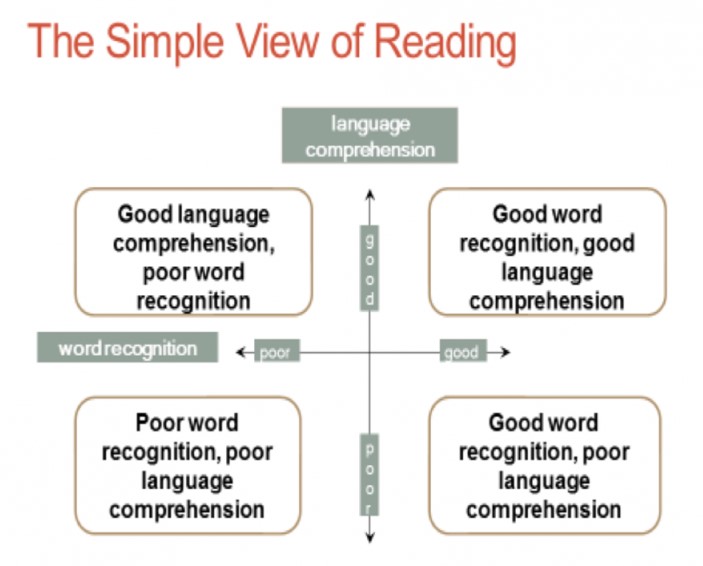
We can become better readers simply by improving in these 2 areas.
Reading vocabulary fluently
Reading improves your reading. The more your child reads, the more words they’ll recognise; and perhaps more importantly, the more confident and comfortable they feel in the act of reading. Ideally, by the time they enter secondary, reading will feel like a second home to your child: it’s something they do naturally – with ease – and it feels wholly familiar.
However, it’s imperative that children continue to expand their vocabulary. Unfamiliar words in a text can break fluency and sometimes cause children distress or result in shaken confidence.
One of the jobs of our subject teachers is to explicitly teach the vocabulary your child needs to access their curriculum. We are building resources on this website to support your child, and you, in working on this at home too.
Learning new words can be quite difficult. For a new word to enter into your child’s long-term memory, they need to be exposed to it around 10-17 times. You can support your child with this by, for example, talking through their new words, putting them on the fridge, or adding them into conversation regularly. You could do this with unfamiliar vocabulary in our St Hilda’s Reads book, if you choose to read along with your child.
Most experts agree that learning the links between the roots of words and parts of words (morphemes) can support students when they similar but unfamiliar words. For example, if a child understands that the ‘bi’ = two, they are more likely to be able to fluently read other words using the ‘bi’ morpheme. A new website www.vocabulous.co.uk is designed to support students with this (though we’ve not tried and tested it yet!) To get you started, you can find a list of commonly used prefixes (morphemes used at the start of words) and their meanings here.
Understanding the meanings of words
We are not simply ‘good’ or ‘poor’ readers. If we are given a text on a topic we know well (Liverpool’s season; I guess also Everton’s season; the history of our city; why the scouse accent is actually brilliant), we will naturally be able to comprehend much of the vocabulary used in the text. Not because we are all amazing readers, but because these are words we’ve heard of before – we use them in conversation regularly and understand the layers of meaning they generate. We can use and understand even the most complex vocabulary for a topic we know and love.
However, if we’re reading a text that we have very little knowledge of, we’re far less likely to be familiar with the vocabulary used; we’re even less likely to understand the nuances and deeper meanings of how these words are used in society.
You can improve your child’s (and your own) chances of understanding a given text by expanding their cultural capital: that is, their knowledge of the world they live in. The more experiences they have and parts of our world they encounter, the higher their chances of comprehending a given text.
Once they leave education, your child will generally have the means to look up specific words, or independently broaden their experiences according to the needs of their lives. However, in their GCSE exams they are faced with unseen texts that could be on any topic, especially in English Language.
This might feel like an insurmountable task but remember that your child doesn’t need to visit places to experience the world; that’s why books are beautiful inventions! Books can take them anywhere!
We’ve chosen books for St Hilda’s Reads that will expose our students to elements of cultural capital that will support them in the classroom – remember we’re all in this together. That said, don’t underestimate the power of a short conversation about a news item, or an observation about how the shape of the city is changing – to quote a leading supermarket chain, every little helps.
If you are interested in thinking more about this, you can watch the following video, which we used when rationalising our St Hilda’s Reads book choices:
 The Home of our curriculum